MotoGP: Ducati 2022. Tutte le differenze fra le moto in pista e i pacchetti tecnici!

Borgo Panigale schiererà otto moto nel 2022 ma saranno tre tipi di moto diverse.
E non è finita qui. Ci saranno molte altre differenze da tenere in considerazione

Ci sono ben otto Ducati in pista per il 2022.
Non è mai successo prima e quindi sarà bene capire subito quali sono le differenze fra i pacchetti tecnici.
Iniziamo col dire che le due Pramac di Zarco e Martin sono identiche alle ufficiali di Bagnaia e Miller.
Del resto le GP22 sono tutte uguali. Quelle rosse del team Factory, quelle Pramac e quella di Luca Marini del team Mooney VR46.
Non c’è alcuna differenza fra specifiche (SpecA, SpecB, etc) anche perché trattandosi di moto nuove, la stessa Ducati non ha avuto il tempo di sviluppare degli step evolutivi che le possano differenziare. Questo almeno per adesso.
Durante la stagione, se ci dovessero essere, verranno distribuiti sulla base della disponibilità.
Facciamo un esempio. Nel 2021, le carene nuove comparse in Qatar, erano nella disponibilità di due per pilota nel team factory, e solo una per pilota nel caso del team Pramac. In altri casi, per altre modifiche, c’è voluto del tempo ma sono comunque arrivate.
Diciamo quindi che per certe cose è una questione di tempo, mentre per altre, di scorta.
Bezzecchi, di Giannantonio e Bastianini avranno invece la stessa moto, con un’attenzione per Enea Bastianini che avrà una moto più evoluta (il motivo lo scoprirete nel prossimo articolo).
Per la 2021, evidentemente, gli step evolutivi, ci sono.

Ma chi pensa che sia solo una questione di moto, ovvero di modello e step evolutivo, non ha tenuto conto di quello che in realtà è l’aspetto più importante in grado di pareggiare le cose se non addirittura di stravolgerle. Parliamo del pacchetto tecnico.
Tutti i team, alla stipula del contratto, al di là delle moto “acquistate”, ricevono la stessa offerta di assistenza tecnica.
Il pacchetto tecnico standard prevede, per due Ducati, la presenza di cinque persone: due capitecnici, due elettronici e un magazziniere, figura che abbiamo imparato a conoscere qui.

A seconda di motivazioni tecniche o finanziarie, questi pacchetti possono essere ridimensionati o estesi ma il numero delle figure rimane invariato.
Gresini avrà ugualmente cinque persone nonostante mantenga un suo tecnico.
Donatello Giovanotti, infatti, lavora per Gresini ma avendo già lavorato con Ducati negli anni precedenti. verrà considerato da Ducati come se fosse factory. Giovanotti is Ducati approved!

Alla fine, quindi, tutti i team avranno cinque persone ma solo alcune che possono essere il capotecnico (come nel team factory e Pramac) e a volte l’elettronico, saranno Ducati.
Per quanto riguarda le assegnazioni solitamente, a meno di incompatibilità particolari, si cerca di mantenere, per un pilota, lo stesso capotecnico e lo stesso elettronico anche nel caso che il rider cambi team e passi, esempio, da un team clienti ad un altro o magari chissà, in ufficiale.
Bastianini, infatti, manterrà Giribuola e Massarin nonostante cambi squadra.

Per Bezzecchi, che invece inizia c’è un tecnico, Flamigni e un elettronico interno.
Per Marini, attenzione, perché come tecnico ci sarà Munoz. Questa è un’anomalia ma è una scelta della squadra che, in questo caso, non si affida a Ducati ma colloca una sua risorsa.

Come si comporta Ducati in queste situazioni?
Per le figure chiave, le valuta, e se ritiene abbiano un livello di preparazione che con un supporto tecnico consenta di gestire le cose in maniera soddisfacente, le mette sotto contratto direttamente.
E’ il caso di Munoz che passa dalla Yamaha di Valentino Rossi alla Ducati di Luca Marini il quale perde il suo capotecnico Ferraccioli che rimane, però, nel ruolo di coordinatore tecnico supervisore. Evidentemente Ducati ritiene che Munoz sia adeguato ma anche che gli serva una supervisione.

In sintesi, sia perché con tante moto in pista spesso mancano le risorse dedicate, sia perché alcuni team hanno già i loro tecnici, spesso si sceglie questo mix and match di situazioni comunque approvate.
In ogni caso il briefing di giornata sarà sempre centralizzato e i dati saranno condivisi.

Questo è il motivo per il quale non c’è da sorprendersi che anche tecnici “esterni” finiscano con l’essere messi comunque sotto contratto direttamente da Ducati.
Le informazioni sono il segreto più prezioso. L’accordo diretto consente a Ducati di sperare in un maggior rispetto della segretezza delle informazioni.

Facciamo un riepilogo delle cose che contano:
Innanzitutto il manico.
Seconda cosa, il model year della moto.
Ma più del model year della moto o dello step evolutivo, conta il tipo di assistenza tecnica che ti puoi permettere.
Perché il pacchetto non è fatto solo dalla moto ma anche dai giusti ingegneri, meccanici, etc.
Le moto gp di oggi sono strumenti troppo raffinati per lasciare qualcosa al caso. Metti che poi vai nel panico e monti male un qualcosa perché non conosci la moto come le tue tasche o, che ne so, ti dimentichi di fare benzina, per dire. Ah è appena successo?
Per quanto sia spiacevole, ci sono piloti migliori degli altri e così via per quanto riguarda tecnici, elettronici, meccanici, etc.

Ah dimenticavo: c’è un’altra cosa, che conta più di tutte queste.
I progetti che Ducati ha per ciascun pilota. Ma di questo parleremo un’altra volta.

Guarda il video e ascolta il podcast!


MotoGP: La figura tecnica inquietante che ha solo Ducati!

La figura più inquietante e temuta all’interno di un team della MotoGp, ce l’ha solo Ducati ma non ne parla mai nessuno.
Quando si elenca lo staff che viene “assegnato” da una casa ad un team privato si parla di capotecnico, poi elettronico, etc e tutti più o meno conosciamo il loro lavoro.
Eppure c’è una figura menzionata a fine elenco, quasi a mezza bocca, forse proprio per nascondere la sua pericolosità: IL MAGAZZINIERE.
Di solito passa inosservato perché nel nostro mondo, il magazziniere è solo uno che sposta le cose, si prende la colpa quando non si trovano,  prepara la roba da spedire, etc.
Senza nulla togliere a questo ruolo, e senza volerlo sminuire, di certo il magazziniere non è una figura temuta, nel pensare comune.
Nelle corse invece il ruolo è un po’ diverso. Scherzando chiaramente, potrei definirlo una creatura una via di mezzo fra un avvoltoio appollaiato su uno spuntone, un giudice supremo e una specie di angelo della morte (per il cliente).

Il compito del magazziniere, infatti, che lavora per la factory che concede le moto e non per il team, non è solo quello di verificare le scorte.
Tenete conto che un team non può rimanere senza ricambi, materiale di consumo e tutto quello che serve per correre. Serve una persona che abbia sempre la conoscenza della situazione. Il team a volte non sa nemmeno quando è il momento di cambiare certe cose. Lo sa il magazziniere che conoscendo la moto e tutti i suoi ricambi alla perfezione, dopo una caduta decide se un pezzo va cambiato o meno, se è recuperabile o no, oppure sa se un certo tipo di materiale quale sensori e altre parti ad elevato tasso di usura, sono arrivate a fine vita e vanno cambiate.
E capirete che cambiare 20mila euro di sensori e non cambiarli, per non parlare di altre parti ancora più costose, non è la stessa cosa.
Il magazziniere finisce con l’essere la figura più fedele alla factory. Più dell’elettronico, che ne difende i segreti. Perché il magazziniere è il professionista che difende gli interessi finanziari di cassa continua, oltre che l’immagine dell’azienda, facendo sì che la moto non si fermi mai per motivazioni che sarebbe stato possibile evitare.
Ed è questo il valore aggiunto di una figura che, con questo ruolo così hard istituzionalizzato, ha soltanto Ducati. Questo elemento di terrore, finisce per essere un vero e proprio valore aggiunto. Soldi ben spesi.
Sentiamo nominare in tv piloti, capotecnici, elettronici e conosciamo i nomi dei più famosi, ma di magazzinieri, non sentiamo parlare mai, eppure un loro errore, e la moto non va in pista o si ferma.
E’ una figura chiave, anche se un po’ spaventosa perché, il magazziniere è quello che presenta sempre il conto.
Chiedetelo a qualche team manager…


MotoGp: What’s wrong with KTM?

There are money, sponsors and a super organization but the riders are fleeing KTM or are in pain. What happens inside the Austrian racing department?


I made you and I destroy you!
My mother could have easily worked in the KTM MotoGP team, since the attitude of the Austrians towards what they gave birth to, seems to be that of my mother when I combined a few and, in truth, even when I didn’t.
Making a brief history of cases of dissatisfaction there are a number of them.
Zarco started, and in unsuspecting times he wanted to give up an official saddle and a few million euros.
A salary he has NEVER seen since he now earns very little at Pramac. And it was also out of his bike without a Red Bull sponsor that publicly humiliated him. You will remember that Zarco, after announcing that the following year he did not want to race with KTM, was fired  in mid-season and deprived of his engagement and sponsors, and said things like: I hope they let me eat. What must have made him want to leave like this?
Pol Espargaro was no exception. Before going to Honda he complained quite a bit. Not to mention Fernandez, who led him to sign in MotoGP that he looked like a dog when they take him to the vet. He was even willing to spend another year in Moto2. An unprecedented thing: he was kicked in the ass to  MotoGP and he still complains. Not to mention Petrucci, direspected since the start, then held and fired too soon but sent to the Dakar as a sop, without conviction with a teams of which the rider from Terni publicly complained because he was not ready and made him risk his life. And then Lecuona.
Ok Lecuona was sacked but he said terrible things. Yet KTM is a cool place. Because it has a crazy “nursery” with initiatives and a phenomenal growth program that many, many, want to escape from. Like Acosta, who has already made him goodbye and told him that he, farewell, wants to leave as soon as possible. The record of anticipated self dismissal. Just like someone who is not well at home with his parents. A place where the managers are very strict, and highly paid, often much more than the riders, it seems a place where you have to do what they tell you, beyond company normality. That is, you have to do what they tell you even if you are perhaps right. What then is the sensitivity, if you do the races. That is to understand if the one you called to risk your life at 300kmh, can give you some advice, perhaps even apparently incomprehensible to you who will also be the owner of the hut but you are sitting in the garage. A very German attitude but without being completely German. Including the very tense relations with Ducati, which in recent years has spent a fifth, and cold to Aprilia, which has spent a tenth and which appears ever closer, too close to remain nice.
It is incredible the parable of KTM which has had incredible moments of growth, which can count on solid money, sponsors and riders, yet it seems to live in the least happy of all possible worlds, a world in which, alone, it creates and destroys itself. KTM started like a bomb but the Blitzkrieg, the flashy approach to quickly conquer the top, failed to work and, on the contrary, wore it out, making it a place to escape. Pedrosa is saved, in the mechanism, being him  no longer a rider but a tester and therefore has passed to the other side.
The arrival of Francesco Guidotti, who will be the Paolo Ciabatti of the Austrians, is perhaps due precisely to this need to soften the structure and bring that know-how that makes the mechanism work to others, who perhaps have less money, but that on certain others things are probably a little more resilient and receptive.
Will he succeed? Perhaps Guidotti has an operational strategy in mind that we do not see. After all, they called him. Otherwise they would have called me, but I’m still here, so…


MotoGp: Cosa c’è che non va in KTM?

Ci sono i soldi, gli sponsor e una super organizzazione ma i piloti fuggono da KTM o sono sofferenti.
Che succede all’interno del reparto corse austriaco?


Io ti ho fatto e io ti distruggo!
Mia madre avrebbe potuto lavorare tranquillamente nel team KTM MotoGP, dato che l’atteggiamento degli austriaci verso quello a cui hanno dato vita, sembra essere quello di mia madre quando ne combinavo qualcuna e, in verità, anche quando non lo facevo.
Facendo una breve cronistoria di casi di insoddisfazione ce ne sono un tot.
Ha iniziato Zarco, che in tempi non sospetti ha voluto mollare così, di botto, una sella ufficiale e alcuni milioni di euro.
Uno stipendio che non ha visto MAI più dato che adesso guadagna pochissimo in Pramac. Ed è stato anche a piedi senza sponsor Red Bull che lo ha pubblicamente umiliato. Ricorderete che Zarco, dopo aver annunciato che l’anno successivo non avrebbe voluto correre con KTM è stato appiedato a metà stagione e privato dell’ingaggio e degli sponsor, ed ha detto ai microfoni cose tipo: spero che mi lascino mangiare. Cosa deve averlo spinto a voler andar via così?
Pol Espargaro non è stato da meno. Prima di andare in Honda si è lamentato un bel po’. Per non parlare di Fernandez, che lo hanno portato a firmare in MotoGP che sembrava un cane quando lo portano dal veterinario. Era disposto a farsi addirittura un altro anno in Moto2. Una cosa senza precedenti.Lo hanno mandato in MotoGP a calci in culo e ancora si lamenta. Per non parlare di Petrucci, schifato sin dall’inizio, poi tenuto e silurato troppo presto ma mandato alla Dakar come contentino, senza convinzione con un team di cui il ternano si è pubblicamente lamentato perché non era pronto e gli ha fatto rischiare la vita. E poi Lecuona.
Ok Lecuona è stato segato ma ha detto cose terribili. Eppure KTM è un posto fighissimo. Perché ha un vivaio pazzesco con iniziative ed un programma di crescita fenomenale da cui però molti, moltissimi, vogliono scappare. Come Acosta, che gli ha già fatto marameo e gli ha detto che lui, ciaone, se ne vuole andare appena gli sarà possibile Il record delle dichiarazioni anticipate. Esattamente come uno che a casa con i suoi non sta bene. Un posto dove i manager sono severissimi, e pagatissimi, spesso molto più dei piloti, sembra un posto dove devi fare quello che ti dicono, oltre la normalità aziendale. Ossia devi fare quello che ti dicono anche se forse hai ragione tu. Che poi sta proprio lì la sensibilità, se fai le corse. Ovvero capire se quello che hai chiamato per rischiare la vita a 300kmh, può dare qualche dritta, magari anche apparentemente incomprensibile a te che sarai anche il padrone della baracca ma sei seduto al box. Un atteggiamento molto tedesco ma senza esserlo completamente. Inclusi i rapporti tesissimi con Ducati che negli ultimi anni ha speso un quinto, e di sufficienza verso Aprilia, che ha speso un decimo e che appare sempre più vicina, troppo vicina per rimanere simpatica.
E’ incredibile la parabola di KTM che ha avuto momenti di crescita incredibili, che può contare su denaro, sponsor e vivaio solidi, eppure sembra vivere nel meno felice dei mondi possibili, un mondo in cui, da sola, si crea e si distrugge. E’ partita a bomba KTM ma il Blitzkrieg, la guerra lampo per conquistare velocemente il vertice, non è riuscita a vincerla e, anzi, l’ha logorata rendendola un posto da cui fuggire. Si salva, nel meccanismo, Pedrosa, che ormai non è più un pilota, ma un tester e quindi è passato dall’altro lato.
L’arrivo di Francesco Guidotti, che sarà il Paolo Ciabatti degli austriaci, è forse dovuto proprio a questa necessità di ammorbidire la struttura e portare quel know how che fa funzionare il meccanismo agli altri, che forse hanno meno soldi, ma che su certe altre cose sono probabilmente un po’ più elastici e ricettivi.
Ci riuscirà? Forse Guidotti ha in mente una strategia operativa che noi non vediamo. Del resto hanno chiamato lui. Altrimenti avrebbero chiamato me, che invece sono ancora qua.


Il limite dei decibel in MotoGP e i maestrini del nulla!

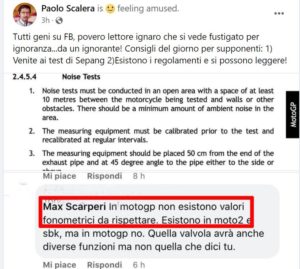
“Tutti geni su FB, povero lettore ignaro che si vede fustigato per ignoranza…da un ignorante! Consigli del giorno per supponenti: 1) Venite ai test di Sepang 2)Esistono i regolamenti e si possono leggere”

Scrive Paolo Scalera,  (nemmeno il coraggio di taggarmi o nominarmi ma ci penso io), che è andato a trovare, nemmeno un mio post ma una mia risposta ad un utente all’interno del mio post in cui dicevo che in MotoGp non ci sono valori fonometrici da rispettare.
Eh no invece di sono, ecco 130db, Misterhelmet è ignorante e fustiga gli utenti.
Allora spieghiamo bene e perdiamo del tempo per sistemare questa faccenda.

Spieghiamo la realtà dei rilevamenti fonometrici a chi legge e decide chi è ignorante e chi no.

I limiti fonometrici in Superbike fino al 2015 erano, mi pare, di 107dB che era già un rumore assordante che hanno poi passato a 115 nel 2016. Qualcosa di insopportabile. Intendiamoci equivale al decollo di un aereo da una media distanza.
Dovete sapere che la misura in dB è una misura in scala logaritmica. Ciò significa che aumentare un livello di 10 dB (equivalente a 1 B) significa aumentare la grandezza misurata di un fattore 10.
PER AVERE UN’INTENSITA’ DOPPIA BASTA AUMENTARE IL LIVELLO DI 3 DB.

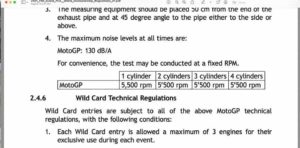
Quindi è sì vero che in MotoGP c’è un limite di 130dB ma è di fatto un non limite perché 130dB non è di fatto raggiungibile, dato che equivale al decollo di un jet, DA VICINO.
Abbiamo detto che aumentare il rumore di 3 decimi significa raddoppiarlo. Ricordate: SBK 115, MotoGP 130. Di decibel ce ne sono 15 in piu. E infatti nessuno si avvicina ad una MotoGP senza cuffie e nessuno guida una Moto GP senza tappi.
Tecnicamente, in Superbike e in Moto2 nei tubi di scarico ci sono dei fono assorbenti e dopo un po’ vano cambiati perché altrimenti si supera il limite stabilito.
In MotoGP NON ESISTE alcun tipo di fono assorbente nei tubi.
Perché a nessuno frega niente, dato che il limite di 130dB non è raggiungibile tecnicamente dai motori motogp.
E UN NON LIMITE.

E a dimostrarlo c’è il regolamento, che stabilisce un massimo di 130dB a 5.500 per i monocilindrici, bicilindrici, tricilindrici, etc. Il che vuol dire che è un parametro impossibile.

E infatti mentre in sbk ogni tot vengono fatte le fonometriche sulle moto usate in gara, in MotoGP le prove fonometriche NON VENGONO FATTE e se vengono fatte non vengono fatte per far rispettare dei limiti perché proprio non c’è pericolo.

Non vengono fatte perché, lo ripeto, 130dB è l’equivalente di un jet in decollo, da vicino e quindi è un livello di rumore non raggiungibile.
Vabbè, è evidente che l’idea era quella di rompere le scatole a me. Facendo il maestrino e puntando il ditino.
Io ho detto due cose: la valvola elettronica dello scarico di cui ho parlato, non serve a stare nei limiti fonometrici perché in MotoGP non ci sono.
Forse avrei dovuto dire che ci sono ma sono simbolici in quanto non raggiungibili.

Fanno i salvatori dei lettori ignari. Però i lettori ignari, per tutta l’estate li hanno presi per il culo con la cantonata più grande degli ultimi 20 anni nonostante fossero stati avvisati.
Sono stati a conferenze stampa farlocche di principi farlocchi e allora il lettore ignaro non era importante perché bastava raccattare dei click .
Carta canta urlavano con in mano il documento del principe che prometteva 90 milioni.
Ecco quello che sono: nozionismo inutile e  stanno ancora rosicando. Spiegano, spiegano e poi non spiegano un cazzo perché non si sono ancora ripresi e stanno ancora nella terapia intensiva della figura di merda che hanno fatto.

Accusano una figuraccia storica che si sono andati a cercare e che li marchierà per sempre.
Quella si che ha fatto rumore. Molto più dei 130dB.


What happens to the old MotoGP REALLY? But really eh!

Factoid

Every once in a while talking to some reader or some colleague, some cliché comes up, which is either partly true but not 100% true or, as in this case, more of a factoid than a fact.

factoid

What really happens to the MotoGP of years past?

There are differences, someone will say, who knows, in the sense that while Japanese motorcycles at the end of their life are pressed and have a shorter life cycle, in the case of Ducati there is really a rental system at various round-trip levels that puts the material back into circulation and there are various circulating evolutionary steps. In short, the bikes last a while and then-and then...and then....
Actually, if you have also heard the story about Japanese motorcycles being pressed, know that it is an urban legend.
It's been done publicly on a couple of occasions just to stop certain trades and say, if you find it out there, know it's fake because we press them. Do you see that we press it? We press a couple of them on a couple of occasions.
Of course you know how our press does investigations, and having seen that they pressed one, they thought that it always happens that way, and the Japanese like to believe that. And the press is pleased to please.
But know, that this is not the case. Jap motorcycles are made to disappear. In the sense that they have a shorter life cycle and then they end up in certified places like some official museums of the houses, some important factories like the Honda plant in Atessa and things like that. So you understand from you that if there are some of them in some places, obviously they are not pressed. At most they are withdrawn. But so if you find a Japanese gp bike for sale, then maybe it's real? 99.9% no.

If you notice, even official Japanese motorcycles are there, but the ones that are there date back to the mid-1980s at most. Then there was a stop. Because of course there was an exaggerated trade as with the relics of saints, and collectors are often the victims of pricks. The entanglements we did in Italy and nord Europe with motogp and others, tarred, especially some special parts, remain in the "annals" of collecting.
I mean, no one presses millions of euros, quiet though you can't even find them around, these bikes. They just don't show you where they put them. Rightly so.

Listen to the podcast or watch the video!


How much do MotoGP cost? Who pays for them? What is included in the price?

MotoGP Bikes

Everyone talks about budgets, money to make MotoGP and the "cost" differences between different bikes.
But how does the mechanism work, in MotoGP? How much do the bikes cost?
How are they bought, rented, and most importantly, who pays for them to whom?
It works like this.
The bikes, of course, are built by the manufacturers and deployed on the track in the factory team and then given to the customer teams.

I used the term concede and it is not a random term. The bikes are not sold.
But how do the teams pay for them?
Actually, the teams do not pay for them, rather they are "provided" by a sugar daddy who makes a dedicated contribution on their behalf.
All teams that field bikes on the track, receive a contribution from Dorna, and in the case of customer teams it happens without seeing any money. This is because the contract, although there are the guarantees of the teams with various levels of access to more or less up-to-date material, is between Dorna and the houses. It is Dorna that guarantees so that the houses get the money, and to make that happen, the teams only see the money go through according to the supply contract.

The contribution, for both customer and private teams, is five million euros, for two bikes for which the bikes are almost always all paid for and sometimes even a little something left over.

A house, let's take an example, Yamaha, that fields a customer team, then receives another three million.
So the amount that Yamaha, but also KTM receives is five million to the factory team, five million to the customer team, and another three million to the house that fields a customer team.
But so does Ducati, which fields four teams receive thirty-two million?
No. Each Ducati team receives five million plus three million for a private team. This contribution is paid only once beyond the number of private teams fielded.

But how much are the bikes actually worth, or rather what is their price?
It depends. The houses in the motorcycle package also include services such as the track engineer and the electronic and other engineers whose value is high anyway, since we are talking about so many races plus so many tests and the man days of these engineers are not cheap. These packages are there in standard, reduced or extended versions. So Dorna 's counter buto provides, in addition to the bike, a certain number of spare parts and technical personnel.

So on the one hand, those who race Ducati have slightly higher costs while on the other hand, in the case of Japanese motorcycles, they might have something left over. It could, because the houses try to go as far as charging for services until the budget is closed, this is to make the most of the subsidy given. Often of goes well beyond that.

Can it be skimmed?
That is another matter. Here is a legend that says Razali last year thought the bikes cost 8 million and therefore had to allocate more money, which then generated some scazzo son the other managerial figure on his team when he found out that instead the price was a little more than half. But that is another story....


Quartararo wants to "make her jealous" and maybe he can "succeed" in it

Make her jealous

I'm fascinated by the "Jealousy" meme, and I thought maybe that's what Quartararo wants to do with Yamaha, given that a renewal negotiation is underway that promises to be articulate to say the least.
Can it work? Here's the explanation!

In podcast and video. They last less than two minutes!


Poll: Where would you like Quartararo?

Quartararo

Fabio Quartararo, così dicono le voci, è tentato di lasciare Yamaha.
Dove lo vedreste meglio? Dove lo vorreste?

Fetish article on Dovizioso's no logo helmet and his salary!

Dovi Helmet

Article for technical material fetishists
Those who noticed that Dovizioso sported an unbranded Shoei helmet (the Japanese brand is not even on the suit), instead of the usual Suomy, may wonder why.

The reasons why he abandoned his traditional KYT/Suomy and wears a Shoei without a logo are explained in the podcast or video, where Dovizioso's actual engagement is also revealed.
The whole thing is about rounding up.
Does he earn too much, too little, or is the figure correct?